Hey there, ever wondered why a linear actuator costs what it does — and if you’re not a mechanical engineer, how the heck you’re supposed to tell if you’re overpaying or getting a dud that’ll die on you in 6 months? I’m Jake, and I’ve been building and selling linear actuators for 8 years now — not the fancy, lab-only ones, the workhorses that go into factory lines, electric truck tailgates, and even that automated greenhouse your cousin swears by. Today I’m breaking down exactly what factors stack up to make your next actuator affordable, worth the coin, or just plain overpriced garbage. Linear Actuator
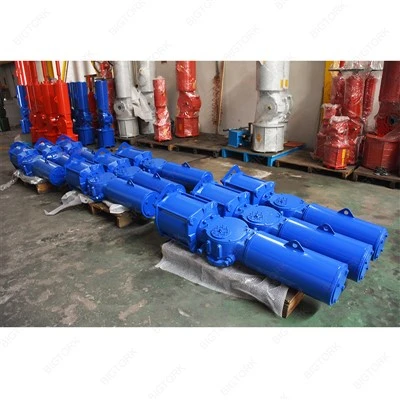
Let’s start with the basics: I used to think linear actuators were just “motors with a stick” when I got into this. Nope. The core is simple — turn rotational motion into linear motion — but the parts that do that, plus how they’re built, tested, and supported? That’s where all the cost hides. First up, the actuator’s biggest workhorse: the motor. Brush DC motors? Super common, cheap, but they’re going to wear out fast if you run ‘em 12 hours a day, 7 days a week. Brushless DC motors? More expensive upfront, no carbon brushes to burn out, way longer lifespan — think 10,000+ hours vs 2,000 for a basic brushed unit. Then there’s stepper motors, which are perfect for things where you need super precise positioning, like a CNC table or a medical pump, but they cost a premium because they have to be machined way tighter. I had a customer a few months back who tried to cut costs on a brushed motor for his conveyor system — 3 months later he was back ordering replacements every other week, costing him more in downtime than he would’ve spent on the right brushless unit. Moral of that story: motor type is your first big cost driver, and it’s not just about the sticker price.
Next up: the drive system that moves that stick back and forth. Ball screws vs lead screws, that’s where most people get confused, and where half the price gap comes from. Lead screws are like the cheap plastic screws you buy at the hardware store — they’re fine for light loads, occasional use, but they create friction, wear out fast, and you have to lubricate them every few months. Ball screws? They use tiny steel balls rolling between the threads, so way less friction, way smoother, can handle way heavier loads (we’re talking 10,000+ pounds for some of our industrial units), and last 20,000+ hours. A lead screw actuator for a 50-pound gate lift might run you $100, while a ball screw unit for the same load is $250… but if that gate has to open and close 100 times a day, the lead screw one will be dead in a year, and you’re out $200 in replacements plus labor. That’s the math I walk every customer through before they pick.
Then there’s the load and stroke, which are the biggest “hidden” cost bumpers I see. Most people search for “linear actuator for [X pounds]” and stop there, but if you get a unit rated for exactly your load? You’re cutting it close. Motors have to work harder when they’re running at max capacity, which shortens their life. If you need a stroke of 6 inches, a 8-inch stroke actuator is cheaper than a 4-inch one? Wait, what? No, that’s the counterintuitive part — the longer the stroke, the more material you need to machine, the more precise the alignment, so it’s actually more expensive. I had a customer last month who needed a 12-inch stroke for his solar panel tracker, and he tried to go with a shorter stroke unit and just mount it at an angle. The thing burned out in two weeks because the motor was working twice as hard to move the panel at an angle. He ended up buying the right 12-inch stroke unit and saved $500 in downtime on his farm that month. Load and stroke aren’t just numbers on a spec sheet — they directly translate to what you pay, and if you get ‘em wrong, you pay for it later.
Environment also plays a huge role, and this is where a lot of cheap actuators fall apart. If your actuator’s going to be outside in the rain, salt air by the coast, or in a dusty foundry? You don’t get a standard $50 actuator from Amazon. You need sealed housings, corrosion-resistant coating, maybe even stainless steel parts. We have actuators rated IP67 for full submersion — those are $200-$500, vs a cheap IP54 unit that’s only splash-proof for another $30. If you put that $30 unit on a boat dock? After 6 months of salt spray, it’ll seize up. We had a fishing dock customer a few years back who saved $100 on a cheap unit, and when it failed, his boat fell and damaged the dock, costing him $2,000. Sometimes the extra $50 is the only thing between a working part and a disaster.
Now, let’s talk about the real “value” stuff that most suppliers don’t mention. Customization. If you need a custom mounting bracket, a special wiring harness, a specific voltage (12V, 24V, 48V, even 400V for industrial), or even a built-in position sensor so you can control where the actuator stops? That adds cost, but not as much as you’d think — and it saves you hours of work modifying a standard unit. We do a lot of custom work for small businesses that can’t afford big industrial actuators, and we price it so it’s not a jump. Contrast that with some big-name brands that charge double for any tiny tweak. Then there’s testing. All our actuators go through 48 hours of continuous run testing, plus load testing at 150% of their rated capacity, before they leave our shop. We’ve had a few competitors’ units come back from customers with broken internal parts — turns out they skip that testing to cut costs. When you buy from us, you’re not just getting a metal stick and a motor, you’re getting a part that’s been proven to work.
But wait, not all cost is worth it. There’s a lot of markup on the market, especially if you’re buying through a third-party distributor who adds 30-50% just for handling the order. That’s why a lot of our best customers come direct — they skip the distributor markup, and we can work with them on price because we’re not paying that middleman. I also see people falling for the “too cheap to be true” traps — $20 actuators for a 100-pound load? Those are made with plastic gears that will strip on the first use, or motors that overheat and die. I’ve pulled apart a few of those “bargain bin” units and you can see the difference in quality immediately — thin aluminum housings, cheap steel that rusts, gears that look like they were made in a garage with a 3D printer. They might work for a one-time home project that only needs to move a flower pot once, but not for anything that has to do any real work.
So let’s put this all together for real, real world prices, so you can get a sense. Basic, light-duty actuators (10-50 pounds, short stroke, indoor use, lead screw, brushed motor): $50-$150. Mid-duty (50-500 pounds, IP rated, brushless or stepper, ball screw): $200-$800. Heavy-duty industrial (500+ pounds, stainless steel, submersion rated, 24/7 use): $1,000-$5,000+. That range is huge, and the difference between $50 and $500 is not just brand name — it’s parts, testing, support.
And here’s the last, most important part: support. If your actuator breaks, do you have someone to call at 2 a.m. when your assembly line is down? A lot of big brands won’t answer after hours, or will charge you $500 for a tech call. We do. If you have a question about installation, or if you need to adjust the stroke, or if you think you got the wrong unit? You text me, or call, and I’ll answer. That’s part of the cost too — knowing that if something goes wrong, you’re not on your own. I’ve had customers call me at 10 p.m. on a Friday because their actuator failed for a food processing plant, and I helped them troubleshoot it over the phone instead of them having to wait for a Monday delivery that would’ve cost them thousands in downtime. That’s value that doesn’t show up on the spec sheet, but it’s worth every penny.

At the end of the day, the cost of a linear actuator isn’t just what you pay upfront. It’s the cost of replacements, downtime, labor, and if you get a bad one, the cost of a disaster. If you’re tired of dealing with actuators that die too fast, or paying markup for parts you don’t need, or getting stuck with no support when something goes wrong, I’m here to help. Shoot me a message, tell me what you’re using the actuator for, what load and stroke you need, and we can work out a price that makes sense for you — no hidden fees, no middleman markup, just a solid actuator that works when you need it.
Linear Actuator References:
- Linear Motion Systems: Selection, Application, and Design. Industrial Press Inc., 2021.
- "Cost Drivers in Motion Control Components". Motion Control Journal, Vol. 18, No. 3, 2022, pp. 45-52.
- IP Rating Standards for Electrical Equipment. International Electrotechnical Commission (IEC) 60529, 2019.
Zhejiang Bigtork Valve Automation Co., Ltd.
Zhejiang Bigtork Valve Automation Co., Ltd. is one of the leading linear actuator manufacturers and suppliers in China. We warmly welcome you to buy customized linear actuator at competitive price from our factory. Contact us for more details.
Address: 98 Yuanqu Avenue,Anfeng Industrial Zone,Oubei,Yongjia,Zhejiang,China.
E-mail: sales@bigtork.com
WebSite: https://www.bigtork.com/
